

ABNA24 - Beirut – For nearly thirty years, I have walked in the Ashura procession in Beirut’s southern suburbs- better known as Dahiyeh.
I have known this procession from every angle. There were years when I stood on the sidewalk as a child, watching the mourners pass by. There were years when I walked among them, dressed in black, one face in the sea of people answering Imam Hussein’s call. Later, I covered it as a reporter, documenting the faces, the chants, the tears and the stories that unfolded every Ashura.
Some traditions are inherited. Others are chosen. This one became both.
For me, Ashura has never been merely an annual commemoration. It is a promise. This year’s procession carried the slogan, Hussein Is Our Path. It is more than words printed on banners. It is a declaration of a way of life. A promise to continue walking the path of Imam Hussein [AS], to stand with the oppressed against the oppressor, and to share, however little, in the suffering endured by the Prophet Mohammad’s Household after the tragedy of Karbala.
The Ashura procession is more than a religious gathering. It symbolizes the journey of the Sabaya, the captive women and children of the Prophet’s family, who were led by Sayyida Zeinab [AS] and Imam Zain Al-Abidin [AS] after the Battle of Karbala. After Imam Hussein [AS], the men of Bani Hashem, his sons, brothers, nephews and companions were martyred beneath the scorching desert sun. The women and children were then taken captive. Marched from Karbala to Kufa and then, to Damascus. Every year, we walk because they walked. We remember because they refused to let truth die with the martyrs.
This year, however, was different.
Not because Ashura had changed.
We had.
For decades, every Ashura procession began at the Sayyed Al-Shuhada Complex before making its way through the streets of Dahiyeh. It was more than a gathering point. It was where generations assembled each Muharram, where black banners filled the square, and where Hezbollah Secretary General Sayyed Hassan Nasrallah, addressed the faithful year after year – before his martyrdom, reminding them that Ashura was not merely an event to remember, but a path to follow.
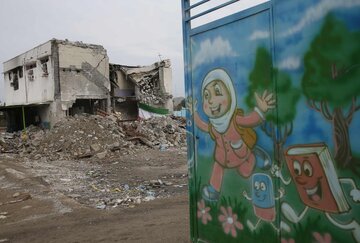
This year, that place no longer existed.
It had been reduced to rubble after being bombed during the latest “Israeli” war on Lebanon, a war that began on March 2, 2026, and once again forced thousands of Lebanese families from their homes.
Instead, the procession began at the shrine of Martyr Sayyed Hassan Nasrallah.
There was something deeply symbolic about that change. The man who once stood at the beginning of the procession to speak to the crowds had himself become the place from which the procession began. His voice no longer echoed through loudspeakers, but his presence was felt in every step that followed.
The starting point had changed. The route had changed. The skyline had changed. But the spirit of Ashura, and the resolve of those who carried it through the streets of Dahiyeh, remained untouched.
Above us, “Israeli” drones hovered, their constant mechanical buzz hanging over the crowds. It was a familiar sound, one that has become part of life in Lebanon, as though even our mourning must unfold beneath surveillance.
Yet beneath those drones walked tens of thousands of people without fear.
The buildings had changed.
The route had changed.
The skyline had changed.
But the spirit had not.
Last year, we commemorated Ashura while carrying the unbearable absence of Sayyed Nasrallah, whose martyrdom at the hands of “Israel” left a wound that still feels impossible to describe.
This year, another absence weighed heavily on many hearts: the Leader of the Islamic Revolution, His Eminence Imam Sayyed Ali Khamenei.
Every year seems to ask us to carry another loss.
Every year, another familiar face is missing.
Yet every year, the procession returns.
Perhaps that is what resistance has always looked like.
This year, though, I was not walking only because it was Ashura.
I was walking with a cause that had become painfully personal.
I walked for every mother who buried the son she once dressed in black each Muharram.
I walked for every wife left to explain absence to her children.
I walked for every child learning what it means to grow up with stories instead of a father’s embrace.
I walked for every father who laid his martyred son to rest.
I walked for every martyr who served Imam Hussein [AS] in these same streets in previous years, believing, as we all did, that there would always be another Ashura to attend.
There wasn’t.
Their places in the procession were empty.
Their names were not.
Among them was someone whose absence I felt with every step.
Someone who walked this procession year after year, not because anyone asked him to, but because serving Imam Hussein [AS] was simply part of who he was.
He stood among the volunteers, welcomed the mourners and gave his time quietly, never seeking recognition.
He never imagined that one day others would walk carrying his memory instead.
He was martyred defending South Lebanon against “Israel”.
As the procession moved forward, I caught myself looking into the crowd, almost expecting to see him where he always stood.
Grief does strange things.
For a fleeting moment, your heart forgets what your mind already knows.
Then reality returns.
And the empty place becomes impossible to ignore.
Watching thousands of people march through streets still bearing the scars of war while “Israeli” drones circled overhead, I could not help but think of another reality unfolding elsewhere.
Our government continues direct negotiations with the very enemy that destroyed our neighborhoods, displaced our families and killed our people.
It is difficult not to wonder whether those filling these streets, those who buried their sons and daughters, are seen as fully belonging to the Lebanon whose name is spoken in negotiation rooms.
Sometimes it feels as though there are two Lebanons.
One counts casualties.
The other counts concessions.
But politics was never the reason I came.
I came because Karbala teaches that dignity is not measured by victory alone, but by remaining faithful to truth, even when the cost is unbearable.
I came because memory deserves footsteps.
I came because some people are gone only if we stop saying their names.
Ashura has never belonged to buildings.
Buildings can be destroyed.
Streets can be bombed.
Leaders can be martyred.
Families can be displaced.
But a people who carry Karbala in their hearts cannot be erased by rubble.
For nearly thirty years, I have walked this procession.
This year, I understood it differently.
This year, every black flag reminded me of someone who should have been beneath it.
Every chant carried a familiar voice now silenced.
Every tear belonged to more than Karbala.
This year, every step had a face.
Every tear had a memory.
Every heartbeat carried someone missing.
Ashura was no longer only about remembering the martyrs of fourteen centuries ago. It was also about remembering our own.
It had become a procession of memories, of names, of absences too heavy to count.
This march was no longer only about history.
And so, with every step I took through the streets of Dahiyeh, I knew exactly why I was there.
This march is for you.
For the one who taught me that serving Imam Hussein [AS] is not measured by how loudly one is seen, but by how quietly one gives. Until my own footsteps fade, yours will never walk alone.
/129



Your Comment